
From the Desk of the NABF General Secretary
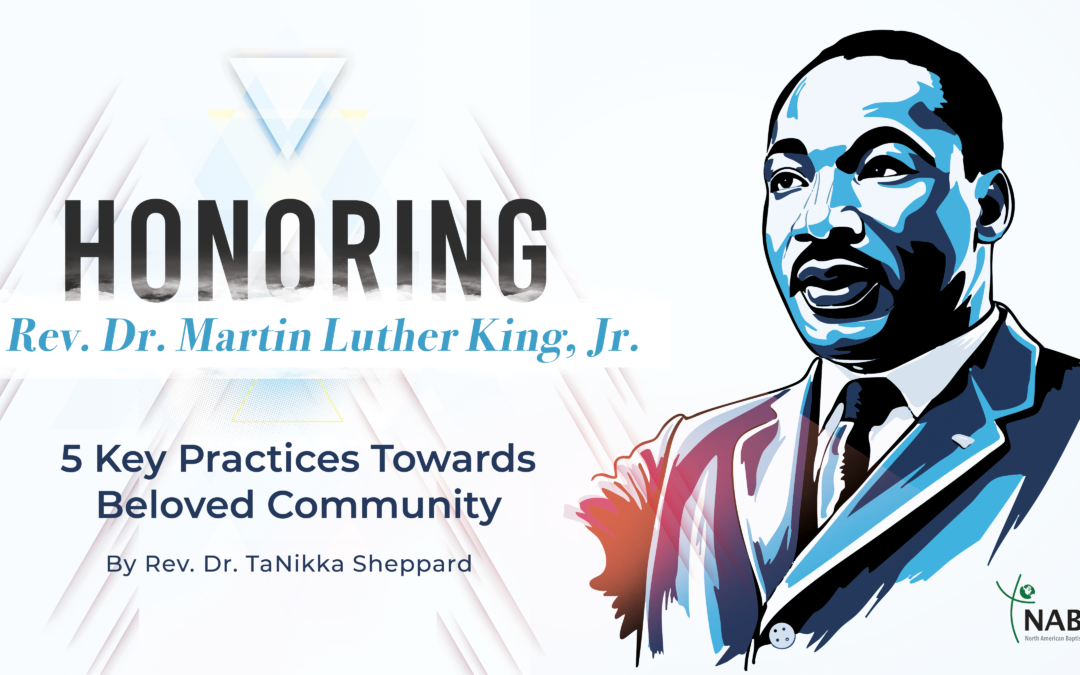
Honoring Rev. Dr. Martin Luther King, Jr.
FIVE KEY PRACTICES TOWARDS BELOVED COMMUNITY
Greetings, NABF Family,
Today is Martin Luther King Jr. Day in the United States, which commemorates the life and legacy of Rev. Dr. Martin Luther King, Jr. Subsequently, many people will have attended worship services, programs, breakfasts, and prayer vigils, drawn together in faithful remembrance, resilient celebration, and a profound longing to renew a vision that Dr. King cast with courageous hope and conviction: The Beloved Community.
As Coretta Scott King, the widow of Dr. King, so eloquently described, the Beloved Community is “…a place of true respect, love, and justice that transcends race, color, or creed.” This concept was first developed by philosopher-theologian Josiah Royce and later given prophetic clarity and brought into the public conscience by Dr. King. This ideal vision offers a powerful framework for our collective mission as followers of Jesus Christ. Rooted in our shared faith, Christ’s love, and mutual care, it calls us into covenantal practices of intentional relationship-building, truth-telling, and shared responsibility that shape how we listen, lead, uplift, and serve across our differences.
On this day, as brothers and sisters in Jesus Christ, we are invited to reflect on and celebrate the prophetic legacy of Dr. King, a Baptist preacher, civil rights activist, and nonviolence advocate whose dreams continue to inspire and motivate people around the world. Notably, in this era, which is also marred by pervasive division, brutality, hate, and hardship, Dr. King’s voice calls us beyond the nostalgic recitation of his speeches. It urges us to take a deep and sobering look at North America, and to recommit ourselves to active engagement in building communities that embody compassion, hope, justice, and shared flourishing for everyone.
In this way, the North American Baptist Fellowship (NABF) has a sacred and urgent opportunity to uniquely model the Beloved Community, not only in this region, but also as a prophetic witness to the wider world. As a diverse community of 35 member bodies, connected through more than 58,000 congregations, Baptist schools and organizations, and reaching approximately 20 million people, we can continue to advance the dreams of Dr. King, and so many other faithful leaders who have come before us to make freedom, justice, and dignity attainable for all.
With that in mind, I am blessed and compelled to share five key practices from Dr. King’s life, paired with his words. These are lessons I treasure and continue to learn from, and I invite you to consider them as we strengthen the Beloved Community within the NABF.
1. PRAYER
“We come before thee painfully aware of our inadequacies and shortcomings. We realize that we stand surrounded with the mountains of love and we deliberately dwell in the valley of hate. We stand amid the forces of truth and deliberately lie. We are forever offered the high road and yet we choose to travel the low road. For these sins O God forgive. Break the spell of that which blinds our minds. Purify our hearts that we may see thee.”
– Martin Luther King, Jr., “Help Us to Work with Renewed Vigor”
Dr. King’s courageous public service was grounded in a devoted personal prayer life. As noted by Lewis Baldwin, Dr. King sought “religious inspiration, personal growth, and an intimate relationship with the God of the universe.” Baldwin observes that Dr. King’s prayers reveal a God-centered faith that sustained and empowered him in every walk of life. As I read the prayers of Dr. King, I am not only inspired, but I am also reminded that every opportunity we have to commune with the Almighty Triune God is an honor and a privilege, a gift that is magnified when we join with other believers, trusting Jesus’s promise that “when two or three are gathered” in his name, he is in the midst of us.
I am thankful for the way prayer draws us into communion with God, opening our hearts and deepening our awareness of what pleases and grieves the Holy Spirit. Prayer can continually recalibrate our moral and theological compasses toward Jesus, so that we do not lose our way amid corrupting secular or political influences. Prayer also provides an opportunity to repent when we fall short, and encourages us to walk a more Christlike path through faithful obedience.
From that place of prayer, I am pleading with the Lord to deliver each of us and our nations as a whole from the lies and idols of race, prejudice, greed, power hunger, xenophobia, and hatred for fellow human beings, sins woven into our histories, systems, and public stories, and whose consequences still shape our common life. In this region of the world, the continuing rise of “Christian nationalism” is a threat to the Body of Christ because this Christ-less, blasphemous ideology weaponizes Jesus’ name to bless coercion, exclusion, violence, and domination. This posture stands in opposition to the Jesus of mercy, truth, and solidarity with the oppressed, it contradicts the biblical truth of the Imago Dei that all people are created in the image of God, and it takes into our own hands the judgment that belongs to God alone. May God help us to stay humble, compassionate, discerning, and hopeful.
For these reasons, as we endeavor to strengthen the Beloved Community within the NABF, I am also praying that God grants us the humility to repent, listen, evolve, and embrace the kind of honest introspection that forms us into a more faithful people. As we pray in the midst of our great diversity, may we do so remembering that we share “one Lord, one faith, one baptism, one God and Father of all” (Ephesians 4:5-6), and may this unity be a living testimony to the Kingdom of God that Jesus is forming among us.
2. PROCLAMATION
“I say it as a minister of the gospel who loves the church…”
– Martin Luther King, Jr., “Letter from Birmingham Jail” (April 16, 1963)
Dr. King’s legacy is immortalized in his preaching and speeches, and I am proud that he is an indelible part of our shared Baptist heritage as a Baptist preacher and pastor. The more I sit with his words, the more I see that real prophetic proclamation is courageous, costly truth-telling that refuses to compromise the gospel for convenience or comfort, or yield to fierce opposition, or threats of retaliation.
Blessedly, Dr. King was not alone in the struggle for justice and civil rights. He had many allies across faiths, cultures, and communities. Yet his “Letter from Birmingham Jail” was written to fellow Christian clergy, reminding us that a substantial amount of the resistance came from other Christians and clergy who sought to discredit him, silence him, and condemn him as an extremist and agitator. It seems that they forgot Jesus’s command to do unto others as we would have them do unto us (Luke 6:31), and perpetuated the hypocrisy of claiming moral authority while refusing others the basic human dignity, access, opportunities, and liberties they themselves enjoyed.
We have the chance to learn from this and not repeat it. Just as in Dr. King’s time, proclamations that expose injustice, including racism, economic exploitation, and dehumanizing exclusion, still carry real consequences. In this hour, truth is frequently downplayed and obscured, while misinformation and false assumptions are widely spread and accepted as fact. Many people are afraid to speak honestly because they may be criticized, targeted, canceled, dismissed, or lose their livelihood, and that fear makes it easier for confusion, lies, and dissonance to keep spreading. However, in this critical moment, we cannot be silent, because silence in response to the suffering of others quietly signals complicity and makes room for such harm to persist. Still, we are not lost. Jesus reminds us that truth not only illuminates, it also liberates: “you will know the truth, and the truth will set you free” (John 8:32). Our faithful proclamation then, is not reckless combativeness, but a love-driven commitment to liberation and dignity for all.
I am grateful that throughout the NABF we are already embodying a commitment to authentic, courageous proclamation, seeking to let truth and love shape both our words and our actions. As we continue this work, let us ask God to search our souls and refine our hearts, remembering Jesus’s teaching that what we speak flows from the heart (Luke 6:45). Together, let us encourage one another to stay steadfast, to speak and receive the truth in love, and to remain committed to words and deeds that bring hope, healing, and dignity in a world that deeply needs this healing work. Such proclamations are essential for the NABF to be a Beloved Community, and our shared faithfulness can be life-changing for those we serve and for one another.
3. PROTEST
“There are somethings in our social order to which I’m proud to be maladjusted. And to which I call upon you to be maladjusted. I never intend to adjust myself to segregation and discrimination. I never intend to adjust myself to a mob rule. I never intend to adjust myself to the tragic effects of the method of physical violence and tragic militarism… It may be that the salvation of our civilization lie in the hands of the maladjusted… God grant that we will be so maladjusted that we will be able to go out and change our world and our civilization. And then we will be able to move from the bleak and desolate midnight of man’s inhumanity to man to the bright and glittering daybreak of freedom and justice.”
– Martin Luther King, Jr., “Techniques of Persuasion in the Montgomery Bus Boycott” (June 24, 1957)
Dr. King’s “maladjustment” was a refusal to accept dehumanizing oppression and violence from those who treated Black people, not as their beloved neighbors, but as lesser human beings. Dr. King’s internal protests and visceral response to such abuse did not merely result in social agitation or disruption. It took shape as disciplined, strategic, gospel-shaped advocacy expressed through boycotts, sit-ins, marches, and sustained civic pressure by many groups, organizations, and churches around the nation. Their actions were righteous responses to laws and practices that denied what inherently belonged to them from the beginning of time: dignity, protection, opportunity, and equal standing in the eyes of God. We cannot underestimate the significance of “Martin Luther King Jr. Day.” Both Dr. King and his contemporaries, along with courageous allies, deserve to be remembered and lauded for pursuing justice with courage, resilience, and hope.
Transparently, I am deeply concerned by how easily the suffering of our neighbors has become normalized in our nations. I share Dr. King’s hope that we, too, would be “maladjusted” in the best sense, unwilling to grow comfortable with injustice and inequity, and that this inner conviction would flow outward into faithful public engagement through organizing, education, demonstration, and advocacy. No matter what, may we strive to fulfill Jesus’s call to do unto others as we would have them do unto us (Luke 6:31), refusing the hypocrisy of protecting our own liberties while denying them to others, and proclaiming the freedom we want for ourselves while withholding it from our neighbors.
I am deeply grateful for the many ways our NABF member bodies reflect Dr. King’s spirit of protest through advocacy and faithful civic engagement, which urges leaders at every level of government to do what is just and right. Whether through advocacy as we seek funding, defend religious liberty, or pursue policy changes that strengthen our ministries, or through public action, including protest, that calls for protections, equal rights, and justice for those who are vulnerable, the orphan, the widow, the poor, and the immigrant, even “the least of these” (Matthew 25), this sustained engagement helps our ministries flourish and our communities thrive. And more importantly, it builds up the Kingdom of God. As we share these efforts and learn from one another’s approaches, may we be drawn into deeper connections and a clearer public commitment to the Beloved Community we are building together within the NABF.
4. PEACEMAKING
“The aftermath of nonviolence is the creation of the Beloved Community, while the aftermath of violence is tragic bitterness.”
– Martin Luther King, Jr., “Address at the Thirty-sixth Annual Dinner of the War Resisters League” (February 2, 1959)
Sadly, Dr. King had an intimate awareness of violence. After all, he was tragically assassinated at the age of 39. Throughout his too-short life, he endured threats, intimidation, beatings, and relentless harassment, including terrifying attacks on his home and ongoing menace against him and his family. Dr. King was not a masochist. Like all of us, he wanted to live securely and keep his family safe.
Yet he, and so many other Black citizens along with their courageous allies, were subjected to the misuse of power and government-sanctioned brutality against those who participated in peaceful protest. They were attacked by police dogs and tear gas, beaten with batons, drenched by fire hoses, and swept into the mass incarceration of the innocent. They also lived under the terrifying, daily shadow of gruesome lynchings, often carried out by masked vigilantes in the night. This included church burnings and bombings, as well as the terror of burning crosses, a Christian symbol of shared faith twisted into a weaponized emblem of religious terrorism. And yet, even amid such incessant violence, neither Christ nor Dr. King’s convictions about nonviolence could be stripped from him. He kept choosing peacemaking, the persistent pursuit of justice, and love.
Peacemaking, as Dr. King practiced it, was not passivity. It was courageous resistance against all forms of violence, including police brutality, mob terror, racial hatred, and militarism, calling all people to a higher plane of moral and civic responsibility, no matter the color of their skin, financial means, or status in society. He refused to accept any form of “peace” that required people to be harmed, silenced, or excluded, and he insisted that peace without justice is simply quiet oppression.Those wrongdoings included segregationist laws that institutionalized dehumanization, voter suppression and disenfranchisement, structural economic and educational inequality that trapped generations in poverty, militarized actions beyond his country’s borders, as well as the surveillance and smear efforts intended to discredit and silence him. Dr. King understood that peacemaking carries a cost, because the way of Christ leads to the cross.
We know that aggression and violence take many forms, including abuse, domestic violence, bullying, human trafficking, terrorism, media violence, war, financial exploitation, threats, and religious intimidation. Without question, peacemaking is extremely difficult and often inconvenient, but it is also a hope-filled practice that carries a divine promise. Jesus said, “Blessed are the peacemakers, for they will be called children of God” (Matthew 5:9). I am thankful that Jesus shows us how to live as God’s children; it is by practicing peacemaking.
As noted by The King Center, conflict is an inevitable part of human experience, yet it can be faced with honesty and resolved peacefully. It does not need to erupt into violence. This is an important component of the Beloved Community of the NABF that we are building together, while always learning how to better cooperate with integrity, mutual respect, and a commitment to the common good. Everyone does not have to agree on everything, nor should we, for it is our diverse perspectives and differences that actually strengthen us. Still, we must be willing to be challenged, to practice accountability, and to refuse toxic suspicions, pressured uniformity, and unchecked power. In this kind of fellowship, disagreement is healthy, it expands our understanding, and when truth can be spoken without contempt and the dignity of every person is protected, then peacemaking becomes more than an ideal. It becomes our shared way of life.
5. PROPHETIC IMAGINATION
“…I say to you today, my friends. So even though we face the difficulties of today and tomorrow, I still have a dream.”
– Martin Luther King, Jr., from “I Have a Dream” (August 28, 1963)
One of the most beautiful practices of the Beloved Community is prophetic imagination. It moves us beyond focusing on what is wrong, toward envisioning and shaping a better shared future, where all of God’s children are valued and free. Dr. King demonstrated prophetic imagination as he articulated his vision of the Beloved Community, which was not a mere fantasy but rather a tangible and collective aspiration designed to contentiously transform the prevailing beliefs of his time… and then mobilize deliberate action toward its actualization. As Walter Brueggemann famously articulated in The Prophetic Imagination,
“In the contemporary practice of prophetic imagination, it will be important to move the church from its comfortable habit of charity to issues of justice…to show the ways in which the old traditions of the God of the covenant makes righteousness, justice, and faithfulness central to common life in a way that resituates, money, power, and wisdom (see Jer 9:23–24; Matt 23:23); and to see how a theology of the cross contradicts our more comfortable, convenient theologies of glory.”
Prophetic imagination is not a solo mission. It requires listening, first to the Holy Spirit, and also each other with grace and curiosity. Just as Dr. King’s “I Have a Dream” speech was inspired by the powerful prayer of Rev. Dr. Praithia Hall, while she was still a young activist, we, too, can be inspired by the visions and dreams of the young prophetic voices in our midst. This is why the Beloved Community must be built together, as we make room for one another’s testimony, sharpen one another’s understanding, share each other’s burdens, and safeguard all places of worship as sanctuaries of refuge… where people can tell the truth, develop authentic connections, be protected, discover their purpose, and grow in the courageous love of Christ.
Undoubtedly, this collective prophetic work is very costly! Jesus explained the maltreatment that prophets often face, which was exemplified in the assassination of Dr. King. Still, we are called to bear witness to God’s alternative, because our love for God must be made visible in our love for our sisters and brothers. As 1 John 4:20 reminds us, we cannot hate our sisters and brothers and claim to love an invisible God at the same time.
The NABF has an incredible opportunity to embody a shared future that is more beautiful and more powerful than the current fractures we see in the Body of Christ and throughout this region of the world. This will require us to pray together, engage together, and love one another with the courage it takes to build Beloved Community across our differences. If we choose to live this way, we can spark hope in congregations and communities across North America and beyond, and make our shared witness a living invitation into God’s Kingdom.
CONCLUSION
May the Beloved Community of the NABF be neither a space for superficial harmony nor a place for hostility, cruelty, or violence. We belong to Christ, and we are called to pursue a love that tells the truth, protects dignity, and holds one another with courage. Any dangerous and hateful divisiveness that seeks to kill, steal, and destroy is not of God, and we must resist it (James 4:7).
As we celebrate today, I am deeply thankful for Coretta Scott King’s lifelong work for civil rights, and for her laborious advocacy over many years to see Martin Luther King Jr. Day recognized as a national holiday. I pray that this day is not dismantled, destroyed, or diminished in an era when the history of African Americans is being discounted and erased before our eyes. When we do not know or remember our history, it is repeated, and the struggle and hard-won advancements for justice and equality that Dr. King and so many others suffered and were killed for become even harder to sustain.
Whether you live in the United States or not, I pray you recognize that in this hour, each of us is helping to write history. Dr. King was not a perfect leader, and we do not honor him well by pretending otherwise. He was criticized for strategies some believed demanded too much restraint from the oppressed, for leadership patterns shaped by a male-dominated era, and for the difficulty of turning moral witness into enforceable, structural change. Yet his legacy remains worthy of honoring because it calls us to greater courage, truth, love, and a future that refuses to surrender hope
The greatest honor we can offer is not merely to quote Dr. King, but to live in ways that honor the righteousness of the work we share. This is cross-bearing work, and leadership means we are responsible for what we do with the time and influence God has entrusted to us. God does not require what God has not provided for, but God does require faithfulness, and the Spirit still provides courage for the tasks of this season.
Therefore, I invite you into three simple next steps:
- Pray and listen across our differences. Reach out to one sister or brother in Christ whose experiences differ from yours and listen with humility.
- Practice public love. Take one concrete act of advocacy or service in your local context that protects the vulnerable and advances justice with compassion and mercy.
- Attend the “NABF Beloved Community: Compassion, Truth, and Justice Forums.” Come ready to learn, build relationships, and strengthen our shared commitments. (Sign up via our Engage page.)
I greatly appreciate you taking the time to read this tribute to Rev. Dr. Martin Luther King, Jr. Thank you for your ministry, your partnership, and your willingness to engage this shared work with openness and prayer. I pray that this dedication to Dr. King encourages you to learn more about his legacy and the impactful work he is still inspiring around the world, be the light of Christ in this dark hour, and keep building the Beloved Community together with enduring faith, hope, and love.
May the Lord make us a holy people with prayerful courage, truthful proclamation,
disciplined protest, courageous peacemaking, and prophetic imagination,
until the bright and glittering daybreak of freedom and justice is not only proclaimed,
but practiced by all and for all. Amen.
Sincerely,
TaNikka Sheppard, NABF General Secretary
North American Baptist Fellowship
tanikka@nabfellowship.org
Read the newsletter version of this article here: https://mailchi.mp/nabfellowship.org/2026-mlk